
Aviation: An Idea… #feasible?
Ande here: This is a ten minute brainstorm…
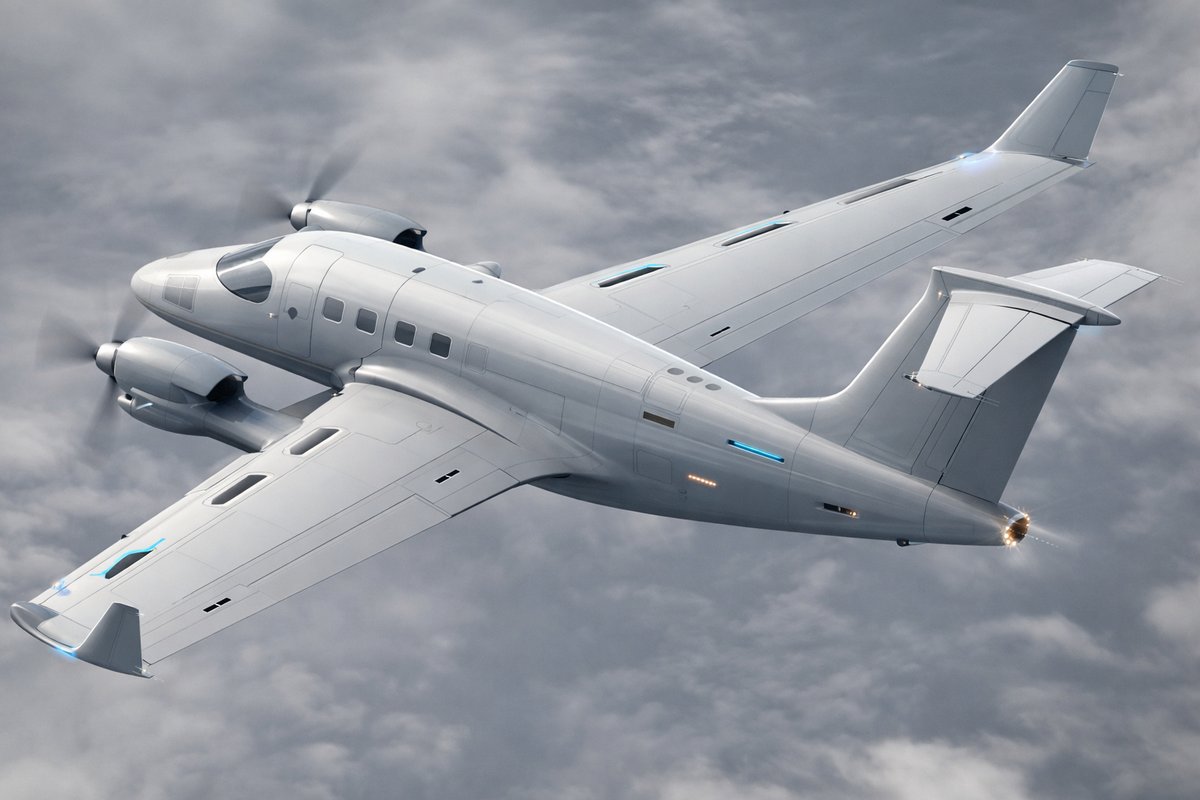
Picture an aircraft that flies like a normal aircraft when it wants efficiency…then, when the air turns ugly or the speed gets low, it stops “hoping the wing behaves” and starts actively shaping the airflow.
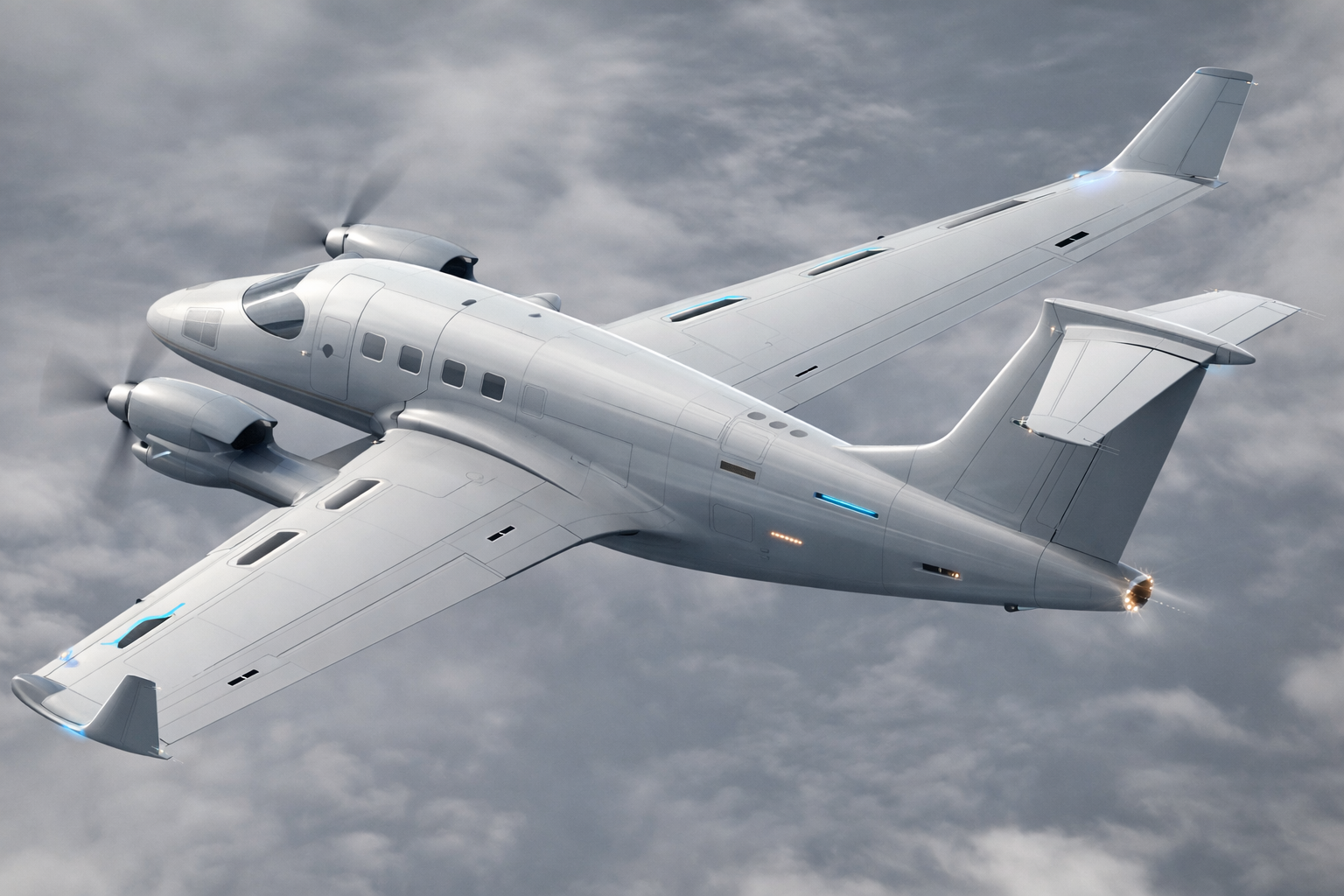
Image one… the craft itself
What strikes first is how little it announces its deviation from orthodoxy. It still reads, unmistakably, as an airplane. That matters. It means the baseline physics remain friendly. Lift is still generated by span, not trickery. Stability still lives in geometry, not computation alone. This is not abandoning the century of hard-won aerodynamic truth…it is layering a second nervous system beneath the skin.
Then the apertures begin to reveal themselves. They do not protrude. They do not demand attention. They are recessed, flush, almost vascular…like pores rather than engines. This is the critical shift. Traditional aircraft push or pull air from a few dominant points. This craft converses with the air across its entire body. It does not merely move through the medium…it negotiates with it locally.
The wingtip ports, in particular, signal intent. The wingtip is the longest lever arm available. Every gram of momentum exchange there multiplies its authority. This means the craft can correct roll and yaw with minimal energy expenditure compared to brute-force tail deflection. It moves from force-based control to leverage-based control. Subtlety replaces violence.
The fuselage side ports tell a quieter story. These are not about lift. They are about composure. They exist to arrest the tiny instabilities that normally propagate unchecked until the pilot or control law reacts. Here, correction happens at the origin of disturbance, not after amplification. The craft does not recover from instability…it suppresses its birth.
The tail outlet, glowing faintly in the render, completes the circuit. It suggests that the aircraft can redistribute its own control authority dynamically. The tail no longer carries the full burden of directional stability. Stability becomes distributed. Redundancy emerges naturally. Failure of one actuator does not collapse authority…it simply redistributes it.
What emerges is not a more powerful aircraft…but a more aware one. One that senses the shape of the airflow and shapes it back in return. Control stops being discrete surfaces interrupting flow. Control becomes modulation of flow itself.
The airplane ceases to be an object in air. It becomes a participant in air.
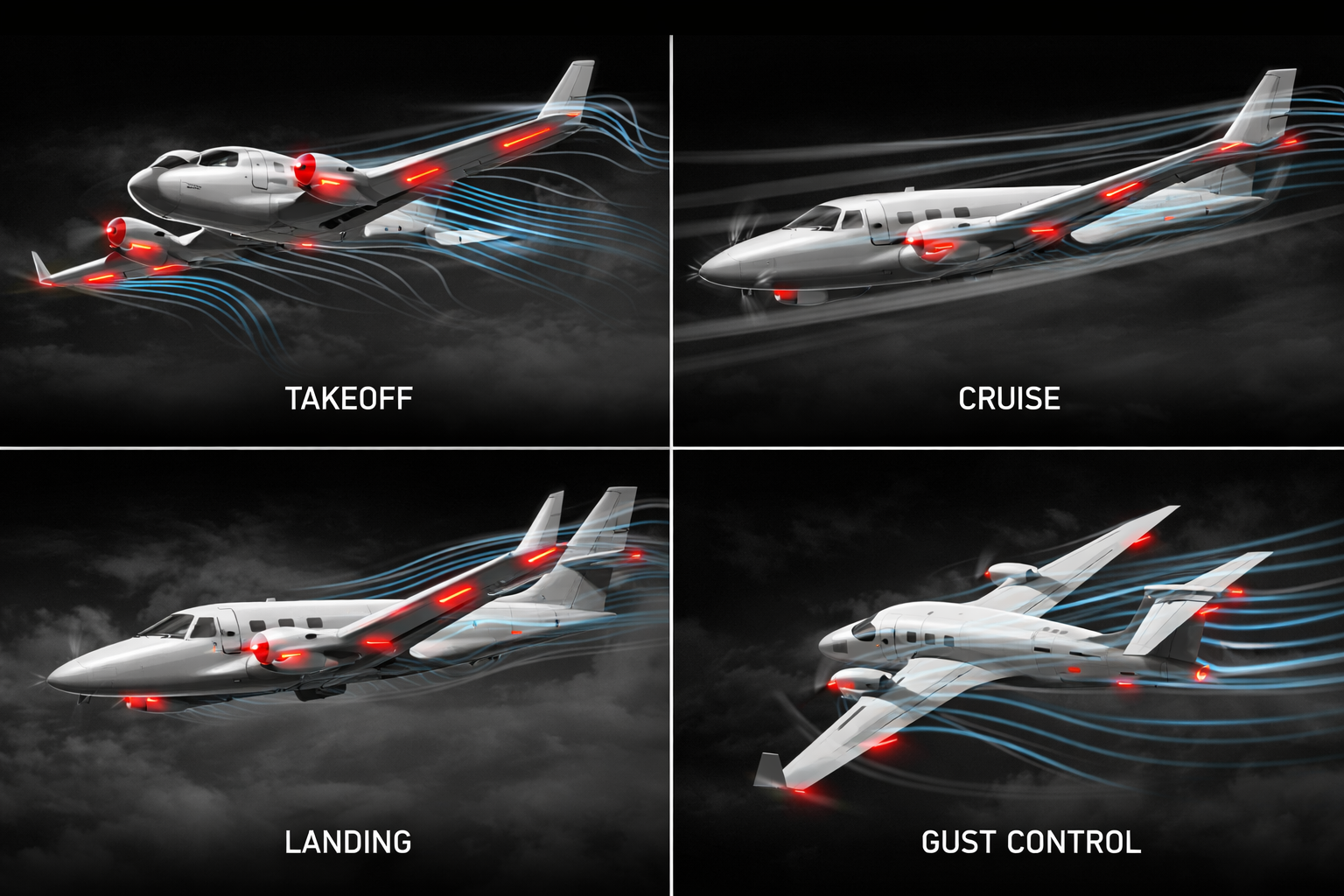
Image two… the montage of modes
Here the concept stops being abstract and becomes temporal. Each quadrant is not a different aircraft. It is the same aircraft expressing different personalities.
In takeoff mode, the red apertures multiply. The craft expands its interface with the air. Flow is no longer allowed to separate casually from the wing’s upper surface. It is shepherded, re-energized, persuaded to remain attached longer than geometry alone would permit. Lift increases not by increasing speed, but by increasing cooperation between surface and fluid. This is the quiet overthrow of traditional stall limits.
In cruise mode, the red almost vanishes. This is the most important detail. The system does not impose itself unnecessarily. It withdraws. The aircraft becomes aerodynamically clean again. The distributed nervous system falls silent. Efficiency is preserved. This restraint is what makes the concept viable. Power is only spent when physics demands intervention.
Landing mode reawakens the network, but differently. Now the emphasis shifts from lift creation to stability preservation. The red points cluster near the wingtips and fuselage sides. The aircraft is not trying to remain aloft indefinitely. It is trying to remain composed while surrendering altitude. It controls the descent not just through thrust reduction and flap deployment, but through direct manipulation of local flow momentum.
The gust control quadrant reveals the deepest implication. Air disturbances are shown interacting with the craft, and the craft responds not by rotating its entire structure, but by adjusting flow locally at the point of disturbance. This is faster. It is more precise. It is less energetically expensive. The aircraft no longer passively endures turbulence. It actively cancels it.
What becomes visible across all four panels is a transition from reactive control to proactive flow governance. Traditional aircraft wait for aerodynamic consequences, then counteract them. This craft intervenes earlier, at the level of flow formation itself.
The red highlights are not engines. They are decisions. Each illuminated point represents a moment where the aircraft chooses to shape its relationship with the air rather than submit to it.
The blue flow lines reinforce the deeper shift. They do not merely pass around the aircraft. They bend in response to it. The aircraft is not only moving through the fluid…it is sculpting the fluid field that defines its own existence within it.
This is the difference between pushing through air…and becoming fluent in it.
Not a weird sci-fi body. Not a flying computer with no aerodynamics. A real airplane with real wings, real control surfaces, real redundancy…plus a second layer under the skin that can push, pull, and steer air exactly where the flow is about to fail.
That is the whole point. Keep the century of good aviation. Add a nervous system.
You know the enemy. Stall. Gusts. Crosswinds. Short strips. Ice margins. Engine-out yaw. Pilot workload. All the places where a “clean, efficient” aircraft suddenly becomes a delicate negotiation with physics.
So you add bigger flaps. Or more power. Or more wing. Or more tail.
And every one of those fixes taxes you in cruise. Drag. Weight. Noise. Complexity.
This idea changes the trade.
Instead of permanently changing the airplane’s shape to survive edge cases, you give the airplane the ability to temporarily change the airflow.
Flush intakes drink from high-energy zones.
Internal compressors store that energy as pressure.
Directional micro-outlets return it where the flow is collapsing or where you need authority.
At low speed, you blow the wing where it wants to separate.
At high angle of attack, you keep the tips alive so the wing does not bite you.
In turbulence, you cancel disturbances before they grow into big motions.
In crosswind, you create yaw moment without huge rudder deflection and sideslip.
Then, in cruise, you shut it down. Doors closed. Outlets sealed. Clean again.
You keep efficiency because you refuse to pay for the superpower when you do not need it.
This is a normal aircraft that can turn into a flow-sculpting machine on demand.
Start at the core.
It is still a conventional aircraft.
That means certification pathways exist.
That means handling qualities are familiar.
That means if the new layer fails, you still have an airplane.
Now it compounds.
Low speed becomes a domain you own.
Instead of “approach speed must stay above stall margin”, you actively extend the stall margin.
Instead of giant flaps doing all the work, you make the wing behave better with smaller, cleaner devices.
Shorter takeoff. Shorter landing. Lower approach speed. Less runway dependency.
Lower approach speed means less kinetic energy.
Less kinetic energy means fewer bad outcomes when anything goes wrong.
The same innovation that shrinks runways also shrinks consequences.
Gusts become cancelable, not survivable.
Today, gust response is mostly: detect motion, then correct motion.
This is late. The aircraft already got kicked.
With distributed jets, you act closer to the disturbance source.
You correct earlier, smaller, and faster.
You reduce the amplitude of the aircraft’s motion, not just the recovery time.
Passenger comfort improves.
Pilot workload drops.
Maintenance fatigue reduces.
The aircraft lives a gentler life while operating more aggressively.
Crosswind and engine-out stop being dramatic events.
Yaw control is no longer concentrated in one surface.
Authority is distributed across long lever arms.
Wingtip authority.
Aft fuselage authority.
Distributed authority.
You generate stabilizing moments without huge surface angles and without waiting for airflow to be strong enough.
This even allows the baseline aircraft to be cleaner.
You do not need to permanently size everything for worst-case physics.
You can temporarily augment physics instead.
Efficiency wins by refusing to be clever at the wrong time.
Most exotic control concepts lose because they are always on.
Always on means always paying.
This system would win by being dormant when unnecessary.
Active only during takeoff, landing, gust response, go-around, or high angle of attack.
Cruise stays clean.
Cruise stays efficient.
Cruise stays dominant.
Redundancy becomes natural.
Lose a cluster, others compensate.
Authority redistributes instead of collapsing.
The aircraft would be in good resilient by design, not by brute structural overbuild.
And most importantly, this is not a single feature.
It is a platform.
Once the airframe has the ability to ingest, compress, route, and inject airflow locally, everything becomes tunable.
Nozzle placement evolves.
Control laws evolve.
Wing behavior evolves.
Capability compounds.
For those who think simply:
Most airplanes can only steer themselves by moving their surfaces and hoping the air cooperates.
This airplane can help the air cooperate.
It quietly pushes and pulls the airflow exactly where needed.
It turns on only when required, and disappears when not.
You get safer takeoffs, safer landings, smoother flight, and better control, without sacrificing efficiency.
For those who think deeply:
This architecture decouples peak control authority from steady-state aerodynamic optimization. Conventional geometry handles mean performance. Distributed, on-demand momentum injection and boundary-layer conditioning handle edge cases. The system converts transient instability into a controllable variable rather than a design constraint. It is not replacing aerodynamics. It is augmenting them with local, reversible flow manipulation.
The essence is simple.
Build the airplane you already trust.
Then give it the ability to locally edit the airflow when physics begins to fail.
Kai’s: Feasibility #attack:
Lane 1… Physics authority (can it actually generate useful forces)
If the outlets are meant to act like “thrusters”, they must exchange real momentum with the air.
• Key constraint: thrust from a jet is roughly F \approx \dot m V.
To get even 1 kN (about 100 kgf) you need, for example:
• \dot m = 5\,kg/s at V = 200\,m/s, or
• \dot m = 20\,kg/s at V = 50\,m/s.
That is a lot of air and a lot of compressor power.
Falsifier: if your power system cannot deliver tens to hundreds of kW of shaft/electric power for bursts, “true thruster” control authority will be weak.
Pass condition: treat “thrusters” as flow control and moment trimming first, not primary propulsion.
Lane 2… Boundary-layer control (the real sweet spot)
Where this becomes genuinely feasible is not as thrusters, but as blowing/suction slots to delay separation and alter lift distribution.
• You do not need huge net thrust…you need the right momentum coefficient locally.
• Slot blowing near the leading edge, flap shoulder, or outer wing can change stall behavior dramatically for modest power.
Falsifier: if you cannot route air to the exact regions where separation starts (typically outer wing, flap hinge region, nacelle/wing junction), you lose the win.
Pass condition: design it as a distributed slot system with short ducts and local plenums.
Lane 3… Cruise penalty (the thing that kills most “always-on” concepts)
Your “wins in every category” promise dies if cruise drag, leakage, or inlet/outlet protuberances remain active.
• Flush inlets are fine…until they leak, whistle, or trip the boundary layer.
• Any open ports can add drag and noise.
Falsifier: if you cannot fully seal ports and keep surface smoothness in cruise, you pay a permanent tax and lose to conventional designs.
Pass condition: hard requirement: cruise-closed, flush, smooth, with verified drag delta.
Lane 4… System architecture (ducting, weight, and losses)
Duct losses scale brutally with length, bends, and small hydraulic diameters.
• Long ducts to wingtips are heavy and lossy.
• Small nozzles clog and ice.
• Valves and plenums add mass fast.
Falsifier: if the system mass exceeds the benefit mass (bigger wing + bigger flaps + a bit more power), you lose.
Pass condition: keep ducts short via distributed compressors/fans near the actuation zones (wing root modules feeding mid/outer wing plenums).
Lane 5… Control and coupling (does it become a stability nightmare)
Blowing changes lift, lift changes moments, moments change AoA, AoA changes separation, separation changes effectiveness…loop coupling can bite.
Falsifier: if the control law cannot be made robust across icing, rain, bugs, partial failures, and manufacturing variation, certification becomes a wall.
Pass condition: use jets for high-bandwidth small corrections, surfaces for low-bandwidth authority, and fail gracefully to “normal airplane”
Lane 6… Reliability and ops (FOD, icing, maintainability)
Ports on wings and fuselage ingest dirt, water, insects…icing is a serious risk.
Falsifier: if intakes/outlets cannot be made tolerant to FOD/icing without heavy anti-ice and filtration, you lose in real-world dispatch reliability.
Pass condition: recessed intakes in protected zones, screens, drainage, anti-ice integration, easy inspection.
Converge… honest feasibility verdict:
• As a hybrid “flow-control skin” that turns on in takeoff/landing/gusts and turns off in cruise: feasible in principle and plausibly superior in specific categories (stall margin, low-speed control, gust response), if and only if you solve power density, ducting/weight, and cruise sealing.